
From Parental Neglect to Policy Neglect: The Continuous Battle of Children of Abuse
Updated: Dec 4, 2025

How many children do you think are reported or investigated for abuse or neglect in the United States?
0%3.9 Million
0%1.5 Million
What is the issue? Why is this important?
Parental child abuse and neglect are some of the most generalized and underresearched health issues in the United States. By limiting the differentiation between various types of abuse and neglect, it blurs the lines between the extent of the penalties caregivers face and the resources that are available to the victim. In 2020, according to Child Rights, the Child Welfare System, nearly 3.9 million children were reported or investigated for abuse and neglect. [1] The reports were made either by law enforcement, teachers, caregivers, medical professionals, mental health services, social services, or general civilians. Among the 3.9 million, nearly 618,000 cases were confirmed and classified as child victims of abuse and neglect. [2] Of the total cases, nearly 10%, 54,000 victims were from the state of Texas alone.[4] Child maltreatment is a growing issue; however, a bigger issue is the distinction between the types of neglect, specifically Willful (intentional) and Situational (unintentional neglect). Most cases and reformation for parents are with the impression of it being Situational neglect, where the caregiver is lacking the resources and education to properly care for the child. The disparity is between the cases where the parents are fully financially and educationally equipped, yet still choose to strip the child away from basic needs. Serious reform in health policy is needed to recognize and support the victims of willful neglect. By adjusting the distinctions made in current policies and creating additional programs, both children and parents can receive the help they need.
Understanding Child Abuse and Neglect
Child Abuse constitutes the intentional act by a caregiver that causes direct harm or risk to a child. This can happen in various forms, such as physical, sexual, or emotional abuse. Physical abuse includes hitting, shaking, burning, beating, or anything that leads to physical injury of the child. Sexual abuse includes exploitation or inappropriate contact, as the child lacks autonomy and is unable to consent. Emotional abuse is led by humiliation, threats, or verbal harm that causes damage to the child’s self-worth, the capability of receiving love, and feelings of safety. Other forms of abuse include medical abuse, where the child is intentionally being made to feel sick or not receiving the proper treatment. Abuse is led from a purely intentional perspective, where the parent is disregarding the emotions and safety of the child.
Child Neglect refers to the failure to meet a child’s basic needs for health, safety, education, or emotional well-being. This includes physical, medical, educational, and emotional neglect. Physical neglect is the deprivation of food, hygiene, safe shelter, or shuttling, which is when a parent consistently and repeatedly leaves temporary custody of the child to others. Medical neglect is the ignorance and denial of medical care of prescriptions needed for a child’s well-being and survival. Educational neglect refers to the failure to enroll a child in an academic institution, resulting in a lack of intellectual development. Emotional neglect is the withholding of love, support, or attention, all of which are essential for a developing child. Neglect, however often overlooked, is broken into 2 types: willful (intentional) and situational (unintentional). Most cases of neglect are assumed to be situational, in the instance that, depending on the caregiver’s circumstance, they face difficulty providing the child with their needs, either due to poverty, unexpected hospitalizations, or a parent with a lack of planning and is seeking guidance on improving. Situational is when the caregiver may not have intended to cause harm, but failed to, and importantly, lacks malicious intent. However, on the other end of the spectrum, there is willful neglect, where, despite having all resources, parents intentionally do not provide for the child. In mitigating the cases of neglect, there is little distinction or focus on the intent of the parent when providing support to these families. There is too much overlap between each, causing over/underpolicing, criminalization, and support that is not specific to their needs/situation.
Among the topics of child neglect, it is categorized into classes, ranging from mild to moderate to severe. Mild neglect does not warrant a report to Child Protective Services (CPS), but may need the intervention of community members. An example of this is a parent failing to put a child in a safety seat. Although it is dangerous, it is not enough to cause immediate harm to the child. Moderate neglect occurs when less intrusive and community interventions have failed, and moderate harm to the child has occurred repeatedly. Examples of this include when a child consistently is dressed inappropriately for the weather, such as sandals in the winter. CPS may be involved in these situations, but more community members are involved in this circumstance. In severe neglect cases, the child is in long-term harm, such as not receiving the medications for the child’s asthma over a long period of time, leading to the child being hospitalized repeatedly. CPS often intervenes at this point and with more correspondence with the legal authorities. [3] Of all maltreatment types, neglect is the highest amongst physical abuse, medical neglect, sexual abuse, psychological maltreatment and other kinds of abuse alone, as shown in Figure 1. [3]

On average, there were approximately 2,000 deaths per year from neglect [5], with about 84% of the children being between ages 0-2 years old. [3]. Figure 2 shows the rate of child fatalities in 2022, with an alarming percentage spike in the infant population. The ones who are most dependent on their
caregivers for survival are experiencing the most disregard and suffering.

Within the child demographics, boys have been notoriously facing more disparities than girls, averaging greater than 60% of cases, indicated in Figure 3. [3] This potentially highlights the gaps of gender equal care, the notion of gender bias showing more wrecklessness or aggression 6 to boys vs girls, leading to parents overlooking the child’s needs. The social stigma of pain reception, that ‘boys are stronger than girls’ [6], are less emotional, or have less needs causes parents to uphold them to higher rates of abuse. [15]

Among child age and sex, the race and ethnic background of the child has shown alarming statistics as well. Figure 4 shows that Black and American Indian children have shown the highest fatalities rates, followed by children of two or more races.

These disparities show the deeper systemic issues such as interracial aggression, poverty, social stigmas, gaps in equal access to healthcare or child protection responses. Systemic factors such as overpolicing, biased reporting from medical professionals, and policies like the Adoption and Safe Families Act, have gravely impacted families of color more. [7]
Contributing Factors of Parental Behavior
Even if parents and caregivers have the resources, there is still a massive increase of children who are still facing abuse, neglect, and not attending to their needs. Willful neglect is not caused by poverty or lack of resources, however driven by emotional immaturity, need for power, resentment or other underlying issues within the parent. Resources and financial stability alone do not guarantee proper care. Individual caregiver factors such as substance abuse and addiction play a massive role in their decision making. Addition usually stems from mental health struggles such as depression and bipolar disorders. In combination of lack of knowledge about the child’s developmental needs in nuanced practices such as not giving water to infants, and young, single parents, and inexperience leads to more mistakes cases of neglect. When the caregiver also has a previous history of facing abuse or neglect, generational trauma can be a driving force in their parental decision making, impacting thier ability to nurture and respond to the child’s needs. Family and environmental factors such as financial stress, abuse or focus on allocation of funds could lead to disregarding the child’s needs. Overspending on meaningless items over nutrition and child support have been big factors in finances controlling the parent-child relationship. Parents could also feel unsupported, translating the anger, frustration or fear of raising a family onto the children themselves, festering resentment onto them. Parents having supports from other family members or friends coild reduce the burden and the mental crises they may be experiencing. Community factors such as living in a community where violence is commonly seen normalizes instability and filters the parents’ perspective of safety for the child. [8]
Physical and Emotional Impacts on Children
Although parents may have many contributing factors, the lack from their struggles are causing irreversible damage to children. Both physically and emotionally, children are facing levels of chronic stress that are damaging their development and translating to their adulthood. Parental neglect leads to the development of chronic diseases like heart and lung diseases, diabetes, and stroke. Malnutrition can lead to metabolic and growth disorders, and stunted brain development which impairs the child’s emotional regulation, cognitive thinking, and risk assessment abilities. Emotional impacts on children are the development of psychiatric disorders such as depression, anxiety disorders, PTSD, personality disorders, and psychosis. Behaviors disorders such as poor impulse control, attention deficiencies, and engagement in criminal behaviors have been seen in children of neglect, as they often mirror their caregivers’ behaviors. This includes substance use disorders as well, developing addictions to drugs and alcohol. They face troubles in relationships, having extreme polar attachment issues, indulging in self-isolating behavior, or unintentionally find involvement in abusive relationships, as it brings up emotions of familiarity. Children to adults also face a sense of worthlessness and fall into self-harm or suicidal ideation/attempts. [9] Emotional neglect from a parent induces physical changes in the brain of the child. In Figure 5 and Figure 6, it depicts the MRI of two three-year old children, one growing up in a healthy environment (left) and the other growing up with extreme neglect.

The scan on the right shows a clear atrophy of the cerebral cortex, or cortical atrophy, which the Chief of Psychiatry at Texas Children’s Hospital states “is something that is more commonly seen in older people suffering from Alzheimer’s disease.” [10] The cerebral cortex is the outer layer of the brain, which is responsible for higher-level functions such as thinking, memory, consciousness, language, and sensory perception. Neglect expedited the decay of these functions, far before development even began.
![Figure 6. Childhood Trauma’s Impact on the Brain [12]](https://static.wixstatic.com/media/76f80b_da3dca14aec84863af9da96a39884930~mv2.png/v1/fill/w_980,h_447,al_c,q_90,usm_0.66_1.00_0.01,enc_avif,quality_auto/76f80b_da3dca14aec84863af9da96a39884930~mv2.png)
Figure 6 shows how the different types of neglect physically damages the various structures and functions of the brain. The purposeful disregard activates different structures of the brain, leading to the overactivation and progression of activation in low triggering environments. This causes dysfunction in the child’s disability to regulate trust, fight or flight instinct, fear, self-control, decision making, and anxiety.
Current Policies and Gaps in Policy Implementation
The current policies that are in place regarding child neglect are mainly based on protecting families, providing resources to parents and the children, and addressing post-incidents. The first policy is a federal framework called Child Abuse Prevention and Treatment Act (CAPTA) intended to fund states for prevention, reporting on cases, and community-based child-welfare programs that address the needs of the children. It requires a Plan of Safe Care (POSC) for infants affected by prenatal substance exposure, to deter mothers from engaging in substance use. It also aims to place an emphasis on investigating cases, providing family support, and maintaining transparency. However, the realistic issues are that it is underfunded and there is an even distribution of the resources among states it has also been shown to be more reactive to abuse vs the prevention of it. There are limited resources on prior intervention, due to the high volume of cases. This policy also focuses on infants and disregards the neglect/abuse of older children. There is a lack of data tracking and accountability of the families after being provided with the services. There is also no clear distinction between intentional versus situation neglect, therefore, the resources provided are quite general, and the parent may opt out.
The next policy available is the Family First Prevention Services Act (FFPSA), passed in 2018. The policy intends to shift the focus from Foster Care to prevention. it aims to keep families together or place the children with their relatives. It encourages research-based programs such as family therapy or addiction counseling. The issues that arise are that it does not address willful neglect and assumes parents want to engage in the services. There are many implementation challenges as many states opt out due to the complexity of the various cases. There's also a narrow focus on substance use and mental health challenges. There are broader forms of emotional neglect, such as narcissism, that many of these policies do not have the resources to handle. There is also limited funding, as the grants provided are significantly lower than the cost of foster care services.
Texas Penal Code 22.041- Abandoning or Endangering a Child intends to criminalize child neglect and endangerment, which includes willful neglect. The penalties vary by severity, as a Class A Misdemeanor is up to one year in jail and or a $4,000 fine. A state jail felony carries a sentence of up to 2 years for intentional or repeated neglect. A Second-degree felony is 10 sentenced if the neglect results in serious bodily injury or death of a child. This policy emphasizes mandatory reporting of bystanders, Witnesses, and people within the community. The issues with this policy are that it focuses only on the punishment rather than the prevention aspect of neglect, due to the generalization of criminalization. It does not account for situational neglect, where families may not be in control of their circumstances, such as poverty or hospitalizations. The policy is reactive rather than proactive, which can lead to family disruption. For certain cases, the neglect could be treatable however, this policy does not account for those options. Only focusing on the punishment aspect of it may lead to parents being more secretive or scared to ask for help, as it may discourage the parents who have mental health issues from actually reaching out, since they fear being prosecuted.
Child Protective Services (CPS) intends to investigate reports of abuse and neglect, which includes willful neglect. CPS decides whether a child is safe to remain at home or needs to be removed, and coordinates with law enforcement and the Department of Family and Protective Services (DFPS) in Texas. It also provides services to families, such as therapy, parenting classes and addiction treatment. The primary goal of CPS is to work towards family reunification whenever possible. However, caseworkers are overloaded, CPS is more reactive than proactive, there is an inconsistent assessment of intent, there is a slow response time, and the process of removing a child from their home, where keeping them in the home may lead to emotional trauma.
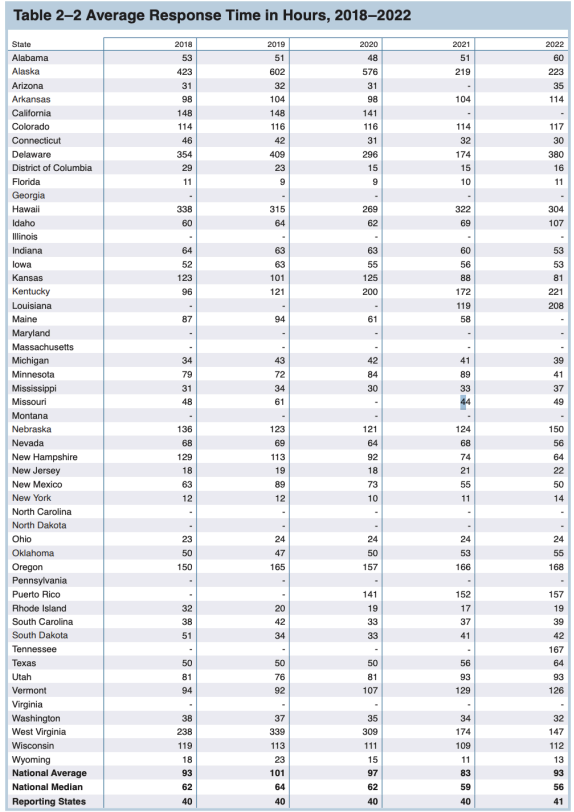
Figure 7 shows that due to various reasons of caseload and overworked CPS workers, the average response time in states such as Texas averages 50-60 hours, and the highest in Alaska and Delaware, nearing 400-600 hours post-call. This shows the extreme delay of response, ultimately, which may lead to a child undergoing more damage by the time CPS arrives or follows up.[9]
Foster homes also intend to provide temporary housing and care for children, removing them from unsafe homes. This system aims to offer stability while CPS investigates and courts decide on reunification or adoption. It also includes programs such as “Kinship Care,” which involves placement with relatives, as well as placement in non-relative foster homes. However, Foster Homes are severely overcrowded, unstable, and there may be cases of emotional neglect within the care. Oftentimes, children in foster homes may age out, which leads to an emphasis on younger children and infants. Foster homes are severely underfunded as well, and many of the foster parents are undertrained. Due to the poor monitoring in-house, there are many cases of abuse that occur as well.
There are also policies, such as the Court Appointed Special Advocates (CASA), which is a volunteer program that assigns trained Advocates to represent children in neglect/abuse cases. Advocates act as the child's voice in court, recommending placements and services that work in the child's best interest. CASA volunteers work alongside CPS judges and attorneys to make the best decision. They help to ensure children receive education, medical care, and emotional support. CASA volunteers intend to be a stable and consistent presence for a child, as that is what many children lack. With CASA volunteers, unfortunately, there is limited availability of volunteers, there is a lack of training for nuanced cases, and advocates may feel overworked. There is a lack of ramifications if advocates show racial or socioeconomic disparity biases towards children, which also leads to the child not feeling as though they have a voice.
Policy Reform Recommendations
To overcome the gaps in existing policies and to open the doors for new ones, the main focus should be on funding prevention and following up on cases. There should be an increase in federal funding for prevention and consistent follow-ups, two to three days post-incident. There should also be additional distinctions between willful and situational neglect for adequate handling to ensure parents and children are receiving the resources based on their nuanced cases. There should be an integrated data system between schools, hospitals, and CPS, with an increase in the access rights that doctors have to a child’s case, especially if they specifically filed a child's case. Currently, once a physician files a report, they are unable to receive updates on the case however, physicians should have the right to receive updates upon request, since follow-up by CPS is inconsistent. There should also be a reduction in case assignments per worker. Currently, each worker has approximately 40 cases, but the load should be reduced to 15. There should also be an increase in pay for caseworkers, which would incentivize more people to work in these programs, ultimately aiding in reducing the assignment load per worker. To further reduce the workload of workers, programs should also invest in community-based centers and kinship care programs. There should also be a National Database to track neglect cases with distinctions between intentional versus willful neglect for more accurate statistics for investigation. Physicians and teachers should also be trained to identify early warning signs of neglect, which prevent many of the issues and damage to the child from progressing. There is a severe lack of prevention measures in current policies, therefore, shifting to this method will protect a larger magnitude of people Physical and sexual abuse are often more visible, and neglect/emotional abuse is often unnoticeable. Figure 8 shows a chart of the signs of child abuse that can be provided to these caregivers.
Help Parents, Protect Children
Neglect is a form of child abuse with distinctions between intentional versus situational. Based on the upbringing of the parents and children, both communities should be provided with adequate care and intervention. Protecting parents with appropriate help will consequently protect children. Communities raise children, not just policies, therefore, having detailed and effective policies is extremely crucial. Standing up for those who cannot stand up for themselves is vital for protecting healthcare reform.
Sources
[1] Children’s Rights. (2023). The child welfare system: 2023 fact sheet. Children’s Rights.
https://www.childrensrights.org/wp-content/uploads/2023/01/CR-The-Child-Welfare-System-202
3-Fact-Sheet.pdf
[2] Kelly, J. (2022). 2020 child maltreatment data breakdown. The Imprint.
https://imprintnews.org/youth-services-insider/2020-child-maltreatment-data-breakdown/62248
[3] Office of Children & Families in the Courts. (2022). Child neglect guide.
https://ocfcpacourts.us/wp-content/uploads/2022/02/3.-Child-Neglect-Guide..pdf
[4] USAFacts. (2023). How many children are victims of abuse or neglect in the U.S.?
https://usafacts.org/articles/how-many-children-are-victims-of-abuse-or-neglect-in-the-us/
[5] American SPCC. (n.d.). Child maltreatment statistics.
https://americanspcc.org/child-maltreatment-statistics/
[6] Kim, J., & Cicchetti, D. (2018). Longitudinal pathways linking child maltreatment, emotion
regulation, peer acceptance, and psychopathology. Journal of Child Psychology and Psychiatry,
60(7), 826–835. https://pubmed.ncbi.nlm.nih.gov/30615163/
[7] Serpeloni, F., Radtke, K. M., Hecker, T., & Elbert, T. (2023). The effects of child abuse on
neurobiological systems: A review. Frontiers in Psychiatry, 14, 1134255.
https://pmc.ncbi.nlm.nih.gov/articles/PMC10543487/
[8] Norman, R. E., Byambaa, M., De, R., Butchart, A., Scott, J., & Vos, T. (2012). The long-term
health consequences of child physical abuse, emotional abuse, and neglect: A systematic review
and meta-analysis. PLoS Medicine, 9(11), e1001349.
https://pmc.ncbi.nlm.nih.gov/articles/PMC4288037/
[9] American Academy of Pediatrics. (n.d.). What to know about child abuse.
[10] Marsh, J. (2017, November 2). Brain scans reveal how badly emotional abuse damages kids.
New York Post.
https://nypost.com/2017/11/02/brain-scans-reveal-how-badly-emotional-abuse-damages-kids/
15
[11] Carr, A., Duff, H., & Craddock, F. (2020). A systematic review of the outcome of child
protection services interventions. Child Abuse Review, 29(5), 371–394. https://rdcu.be/eQAex
[12] NSPCC Learning. (n.d.). Recently published case reviews.
https://learning.nspcc.org.uk/case-reviews/recently-published-case-reviews
[13] Casey Family Programs. (2021). Child abuse and neglect fatalities.


Comments